


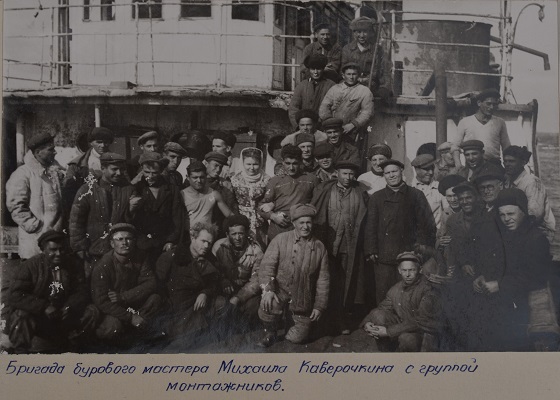
The Documentary Sources Fund of the National Museum of History of Azerbaijan preserves a rich collection of materials documenting the formation and development of the country’s oil industry. The beginning of offshore oil production represents a particularly important chapter in the history of Azerbaijan’s petroleum industry. Among the valuable materials related to Oil Rocks, which became a symbol of the development of offshore oil fields, is the album «Integrated Development of Offshore Oil Fields in the Azerbaijan SSR».
The album contains photographs documenting various aspects of Oil Rocks and its operations. They depict the first drilling rigs constructed directly at sea, trestles and trestle platforms, the workers’ settlement, production facilities, as well as the vessels and their crews that provided transport links with the oil field.
Oil Rocks is located in the Caspian Sea, approximately 110 kilometres east of Baku, and falls within the administrative territory of the Pirallahi District. On November 7, 1949, the first commercial flow of oil was obtained at Oil Rocks. The area, known at the time as the “Black Rocks,” was subsequently named “Oil Rocks.”
In December 1950, the first oil was obtained from wells drilled by oil workers’ brigades led by Gurban Abbasov and Mikhail Kaverоchkin. On February 18, 1951, the first tanker carrying oil produced at Oil Rocks departed from the field. Construction of trestles and trestle platforms began there in 1951, marking an important stage in the further development of the oil field.
During the early years, passenger and cargo transportation to Oil Rocks was carried out exclusively by sea. On June 20, 1960, a helicopter made its first landing at Oil Rocks.
Since 1952, Oil Rocks has functioned as a settlement within the Pirallahi District. Over the decades, it has acquired a special place in the history of offshore oil production and has become one of the most prominent symbols of Azerbaijan’s oil industry, scientific and technological advancement, and the dedication of its oil workers.
It is therefore no coincidence that national leader Heydar Aliyev described Oil Rocks as a magnificent monument to the labour heroism of Azerbaijan’s oil workers.

September 18 marks the birth of two prominent figures in Azerbaijan’s musical culture — Uzeyir Abdulhuseyn oglu Hajibeyli and Muslim Muhammed oglu Magomayev. Through their creative work and multifaceted activities, both made a significant contribution to the formation and development of professional music in Azerbaijan.
The memory of Yasen Ahmadov is also preserved at the National Museum of History of Azerbaijan.
The events of September 1918 are also reflected in the military decorations, archaeological finds, and other material objects preserved in the collections of the National Museum of History of Azerbaijan.
On September 9, 2026, a specialty exam was held at the National Museum of History of Azerbaijan for applicants seeking admission to the Doctor of Philosophy (PhD) program.
On September 1, marking the anniversary of the death of the renowned philanthropist and entrepreneur Haji Zeynalabdin Tagiyev (1838–1924), staff of the National Museum of History of Azerbaijan visited his grave in Mardakan.